Customer Identity Resolution Across DTC Data Sources
Brands lose revenue when scattered data prevents automations from reaching the same customer twice.
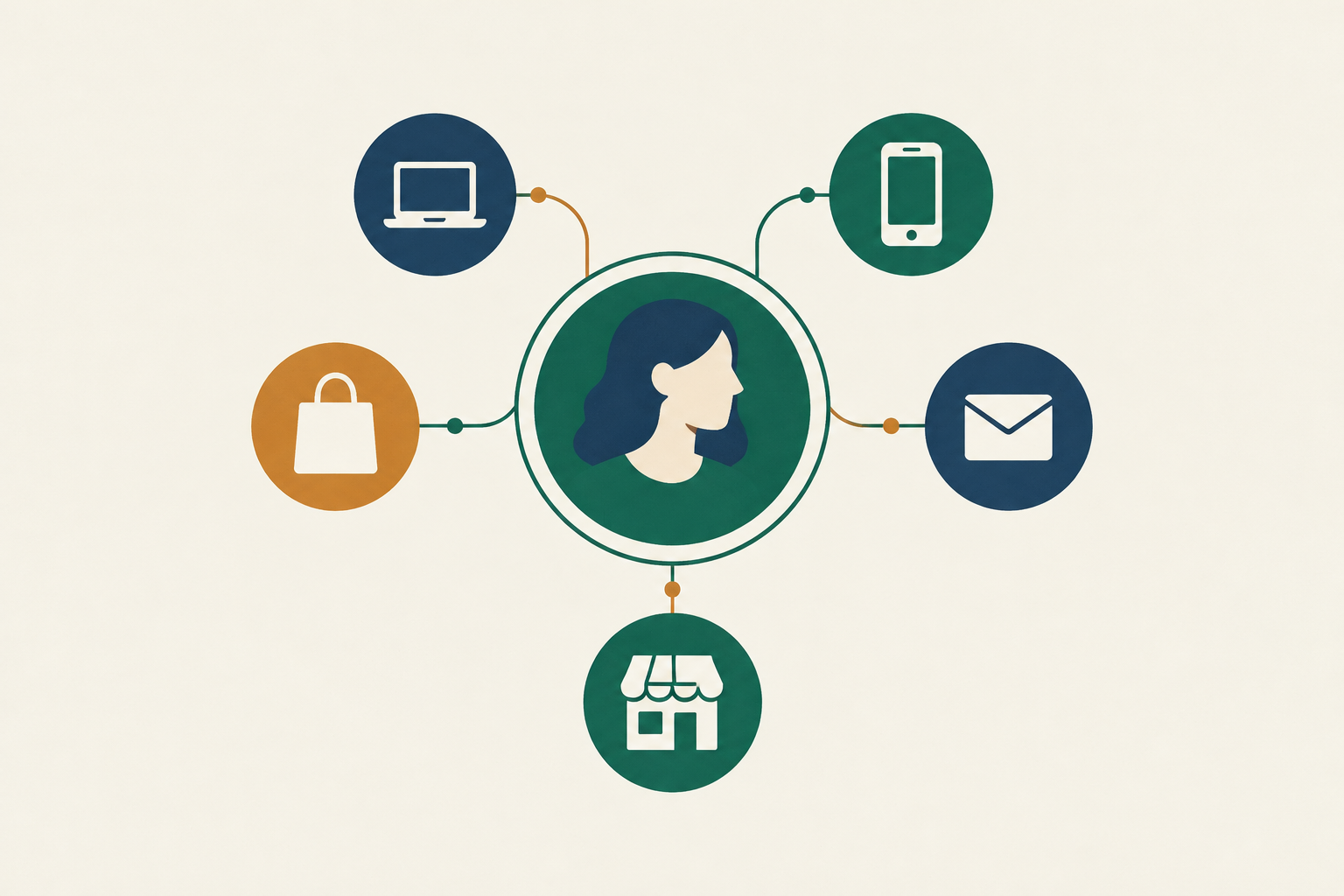
Customer identity resolution across DTC data sources connects scattered shopping records to the real people behind them. Without that connection, brands misread acquisition costs, understate customer value, and lose recovery revenue when automations never trigger. A resolved identity layer is therefore the prerequisite for customer intelligence, from reliable measurement and audience targeting to useful AI-assisted shopping.
Why the same shopper registers as multiple strangers across a typical DTC stack
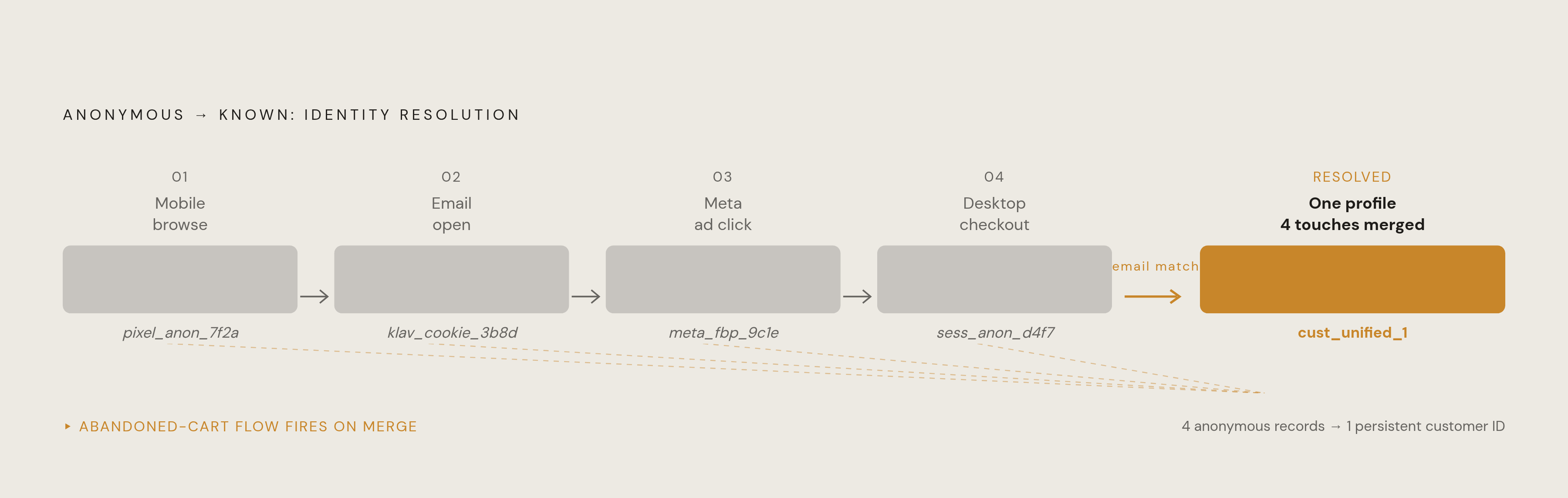
A shopper browses on mobile, opens a Klaviyo email on a laptop, clicks a Meta ad, and checks out on a desktop. The stack records one buyer as four unrelated strangers. Shopify has the order, the email platform has the interaction, and the ad account has its own view of the conversion. SMS, loyalty, and POS systems add their own records, with no shared customer key to link them. Records routinely remain unlinked across the stack even on an ordinary customer journey.
Native Klaviyo tracking captures only a fraction of behavioral events, while dedicated identity resolution infrastructure reaches roughly 55% or more of those events. That coverage gap includes abandoned carts and browsing sessions that never connect to a contactable person. No resolved trigger means no recovery sequence fires. The brand loses a chance to recover revenue even though it has already built the flow, and its customer metrics use the same unlinked records.
What "identity resolution" actually means in a DTC context, and what it is not
Identity resolution matches identifiers belonging to one real person, including email, device ID, Shopify customer ID, ad-click ID, and phone, and connects them in a trusted, unified profile. Its pivotal moment is the anonymous-to-known transition. A visitor browses without identifying themselves, then supplies an email or completes a purchase, allowing earlier sessions to join the known buyer’s timeline. Some implementations create a golden record, but the terms are not interchangeable. A unified profile connects records, while a golden record selects a single best value for each field. Neither is login or access identity management, which governs who can sign into an application. Consent-based partner-network resolution connects opted-in signals to someone who actually visited the brand’s site and expressed intent, rather than supplying cold contacts with no demonstrated interest.
How deterministic and probabilistic matching work, and why the choice matters for Shopify brands
Deterministic matching uses hard identifiers, including email, phone, customer ID, and login credentials, to connect a session to a known person. Its strength is confidence in the link. Its limitation is that the visitor must have identified themselves somewhere in the connected journey. For Shopify brands in 2026, the recommended default is deterministic-first matching built on first-party, server-side signals. That approach centers the most reliable customer evidence and operates independently of third-party cookies.
Probabilistic matching extends coverage through behavioral signals, device fingerprinting, and statistical inference. It can link sessions to people when hard identifiers alone cannot. The trade-off is a risk of merging two different people, which can contaminate the purchase history and behavior assigned to a profile. Most consumer-facing tools combine the modes, using deterministic links as anchors and probabilistic signals to extend into anonymous traffic. The choice is therefore not simply between two competing technologies, but between different balances of precision and reach.
That balance is difficult to judge from a headline match rate. Demo rates can run materially above production results, while company-level B2B matches may appear in figures presented as person-level coverage. Geography also changes the result substantially. US-only rates tend to be highest and fall sharply for international traffic. For a Shopify operator, the useful evaluation question is how many additional abandoned-cart flows actually triggered and what incremental revenue they produced.
The collect-match-merge-activate pipeline and where it breaks in a real Shopify stack
Collection begins when a shopper views a product page, adds an item to a cart, or starts checkout. A storefront pixel captures those actions as signals of intent. However, browsers and ad blockers can block or throttle client-side scripts, making first-party, server-side capture the reliable basis for Shopify collection. Missing events cannot be matched later in the pipeline. A buyer may have shown clear purchase intent, but the downstream system cannot act on an event that never entered cleanly.
Matching connects the collected session to a person-level record through an identity graph built from consented sources. In the same Shopify journey, the visitor’s later email submission or purchase creates the opportunity to connect earlier anonymous behavior to a known buyer. Deterministic evidence establishes the high-confidence link where available. Probabilistic signals can extend that connection where direct identifiers are absent. This is where the precision-versus-reach trade-off becomes an operational decision about which records belong together.
Merging then brings the matched records under one persistent customer identifier across devices and sessions. The desktop order and earlier mobile browsing should now belong to the same buyer. Deduplication is the critical control at this stage. If duplicate records survive, the brand can still count an inflated audience or count one conversion more than once.
Activation makes the resolved profile usable in Klaviyo flows, Meta custom audiences, SMS sequences, and retargeting. For the shopper who left a cart behind, this is the stage that allows the recovery automation to fire. Delivery to the next system is not incidental. If an uploaded customer list has no identifiers such as phone numbers, postal addresses, or device IDs, an ad platform may be unable to find those people in its own identity graph. The campaign’s usable audience shrinks before an impression runs.
In practice, the most common breaks occur at collection and activation. Records enter without hard identifiers, or stale email addresses and phone numbers weaken the connection to the intended person. Siloed systems preserve duplicates even after other records have been reconciled. Professional buyers may have no B2B2C linkage, and creator and influencer audiences may still have no link to the customer graph.
How fragmented identity inflates CAC, understates LTV, and silences automations
CAC gets skewed when Meta, Google, and Klaviyo each claim full credit for the same conversion. The sum of attributed revenue can be higher than the revenue recorded in Shopify because each channel counts the same sale as its own success. The budget consequence is more serious than untidy reporting. Channels that double-count an order can look as though they bring in enough sales to get more spend, which helps drive up acquisition costs. Without a shared identity layer, there is no reconciled journey to check those claims against when measuring blended CAC and channel attribution.
LTV understatement begins with a different error, which is treating a returning buyer as a new customer. A checkout on another device or with a slightly different email can split that person’s orders across profiles. The repeat-purchase rate then looks artificially low. Cohort LTV curves flatten prematurely because later orders are assigned to another apparent customer, while new-customer CAC can look artificially favorable because the new-customer count is inflated. Fragmented identity can both drive up acquisition costs and push different reports in different directions, leaving a brand with inconsistent accounts of the same business.
Browse-abandonment and cart-abandonment flows require a session to resolve to a contactable identity before they can trigger. When that connection fails, the shopper leaves without receiving the sequence. The flow can be correctly built and still remain silent. Unlike a misleading attribution report, this failure removes the recovery attempt itself, so improving the message or timing cannot repair the missing identity link.
These errors compound as the customer dataset changes. Email addresses and phone numbers become stale, separate records accumulate, and later behavior continues to attach to incomplete profiles. Lookalike modeling then extends the original fragmentation into acquisition. A model trained on those records can produce segments that drift further from the real customer profile with each update cycle. Without ongoing identity maintenance, these errors affect both how the brand measures past results and who it targets next.
What a resolved identity layer actually enables, from accurate measurement to fired automations
A resolved identity layer improves the tools already in the stack by giving them a coherent account of each buyer. Every order can count toward the same customer’s LTV, and cohort analysis can track what people actually buy. Returning buyers become recognizable as returning buyers. That recognition supports win-back and loyalty flows aimed at existing customers. The gain is not simply cleaner data, but a usable history for each customer relationship.
A conversion claimed as three channel successes can be counted once, so the brand can base its budget allocation on reconciled evidence. Earlier ad touches, email interactions, and purchases become one path. That path is a prerequisite for trustworthy incrementality testing, although identity resolution does not itself establish which touch caused the sale. It supplies the connected records needed to ask that question properly.
Activation turns this improved account of the customer into a timely response. Browse-abandonment, cart-abandonment, and post-purchase sequences can use the resolved session and purchase history rather than waiting on a connection that never arrives. Flows that were silent can now bring in revenue. People-based marketing also becomes possible because targeting can follow a known individual’s actual behavior. The distinction is between a demographic group interested in fitness and a particular person who browsed a product three times in the past week.
Audience building benefits from that same specificity. Lookalike models train on cleaner seeds, suppression lists exclude the intended people, and prospecting can reach genuinely net-new buyers. The activation platform need not change for those inputs to improve. Segmentation gets more accurate because the records behind it show real customers and what they do. This resolved layer also becomes the data substrate for AI shopping experiences, connecting customer intelligence to the tools that assist discovery and on-site conversion.
Why resolved first-party identity is the prerequisite for AI-mediated discovery and on-site conversion
AI shopping agents from ChatGPT, Google’s Gemini, Perplexity, and Microsoft Copilot already research, filter, and in some cases transact on behalf of shoppers. They use structured, machine-readable product data, review signals, and brand information, as well as what the visual storefront shows. When a brand has no resolved first-party identity or enriched, structured product data, outside models must piece together a view with parts missing instead of using the brand’s own joined-up information.
An AI sales assistant or conversational commerce agent can give a context-aware response when a visitor resolves to a known profile. Without that history, its answer remains generic. Purchase history, behavioral signals, and real cohort LTV give unified brand intelligence a sounder basis for useful, differentiated answers. Structured product information and resolved customer information do different jobs, but both are needed to link what the brand sells with what the shopper needs.
For DTC brands, the practical sequence is identity resolution first, then enrichment, then AI activation. Reversing it gives the AI layer the same incomplete records that already distort measurement and silence flows. Resolving and enriching the underlying data supports recovery automations now, more useful AI responses today, and a more accurate starting point for future AI channels. The advantage grows as each new use draws from the same maintained customer history.
The shopper who appeared as four strangers across browsing, email, advertising, and checkout can finally be treated as one real buyer. Their sessions show the journey, their orders show how much the customer is worth, and their resolved profile lets the brand follow up based on what they did. Each system works from a connected customer history. That is the foundation for measuring, reaching, and serving the buyer accurately across every channel, whether the next interaction is human or AI-mediated.