Incrementality vs Conversion Rate Lift as Proof Standards
Why your rising conversion rate might signal zero new revenue.

A DTC brand can watch its conversion rate climb every day for a quarter and still be generating zero net-new revenue. Conversion rate lift measures whether something changed, incrementality measures whether the marketing spend caused it, and for brands now competing against AI shopping agents that research and decide before a shopper ever lands on-site, only the second standard holds up as proof.
Conversion rate lift is the observed difference in conversion rates between a group exposed to a campaign and a baseline group that wasn't. It's a useful number. It is not, on its own, evidence of causation, and the distinction matters more now than it ever has.
The core problem sits inside every attribution model in use today: they assign credit to whichever touchpoints preceded a conversion, not to whichever touchpoint actually caused it. Last-touch attribution takes this to its logical extreme, handing full credit to the final channel a shopper clicked before buying and ignoring every earlier influence, including the possibility that the sale would have happened with no ad at all. That absent alternative, the sale that would have occurred anyway, is exactly what conversion rate lift cannot see and exactly what incrementality testing is built to measure.
The illustration shows up constantly in brand search campaigns. A dashboard reports thousands of attributed conversions from paid brand search, and it looks like the campaign is working. Run a lift test against it, though, and lift testing often reveals that 60–80% of those same conversions would have happened through organic search if the paid campaign had never run at all. The shopper already knew the brand name. They typed it into Google with purchase intent already formed, and the paid ad simply intercepted a click that organic search would have caught anyway.
That's how a rising conversion rate on a dashboard can coexist with flat or zero net-new demand, and no attribution report is built to flag the difference. For a DTC brand allocating budget against AI-assisted shopping journeys, where a growing share of purchase decisions form before a shopper ever touches the brand's own tracked surfaces, trusting conversion rate lift alone means optimizing for a metric that flatters channels capturing demand that already existed, rather than channels creating demand that didn't.
What the attribution stack broke, and when
Apple's iOS privacy changes, the deprecation of third-party cookies, and the sheer complexity of tracking a shopper across phone, laptop, and tablet converged to break attribution as a strategic tool. None of these forces are new individually, but together they've made the numbers on a platform dashboard increasingly disconnected from what actually happened.
Platform-reported conversions from Meta and Google routinely diverge from what a brand's own site analytics show, and from what actually lands in the bank account. Finance teams noticed the gap first and, in response, largely stopped accepting a dashboard ROAS number at face value. Multi-touch attribution took the hardest hit: the measurement vendor Measured has described MTA as "no longer feasible for most brands," precisely because it depended on user-level tracking that iOS privacy changes and cookie deprecation have since eroded.
The distrust is visible in survey data too. Per the IAB and the BWG's Global State of Data report, roughly 75% of marketers say their measurement systems lack the speed, accuracy, or trust they need to make confident decisions. Nielsen's 2025 research found only 32% of marketers globally measure spend holistically across digital and traditional channels, and most are still working from partial pictures even before automated discovery methods entered the equation. The gap between using an AI tool and proving what it's worth is, in large part, a measurement gap, not a capability gap.
The same signal loss that broke multi-touch attribution left incrementality testing largely untouched. Holdout experiments compare group outcomes rather than stitching together individual user journeys, so they don't depend on cookies, device IDs, or cross-domain tracking to function. And that resilience matters more by the month, because AI shopping agents now research and filter products on a consumer's behalf well before a brand's own site is ever visited. Those influences leave no last-touch footprint. Conversion rate lift, pulled from any platform-reported source, misses them completely.
How incrementality testing works: the counterfactual made measurable
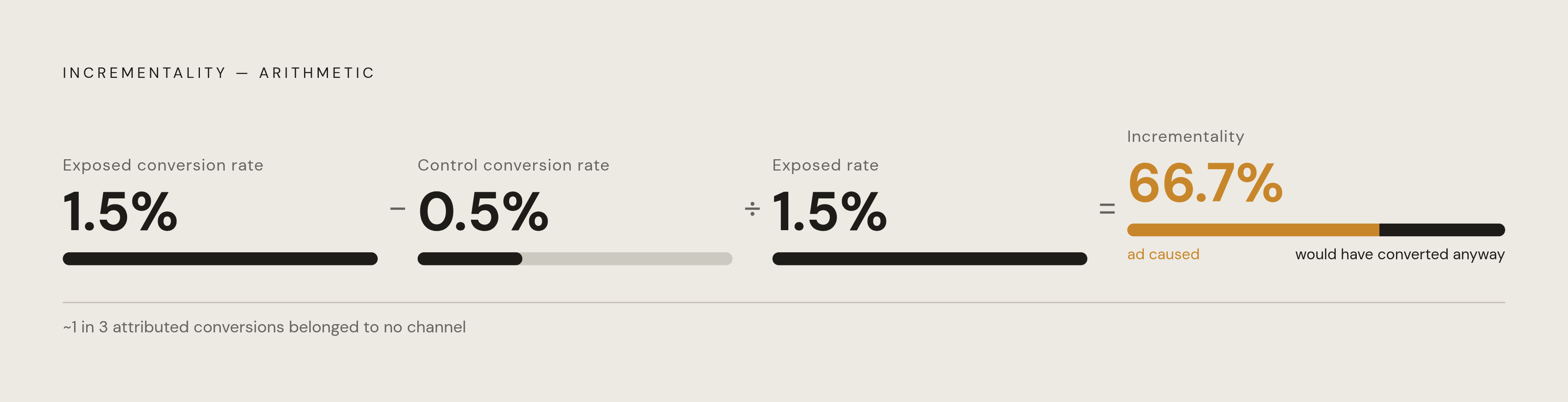
Incrementality is the share of conversions that happened because of an ad, not merely alongside it. It isolates causal lift by comparing two groups that are otherwise comparable, one exposed to the marketing, one held out from it, and measuring the gap between them.
The arithmetic is simple once the groups are set up correctly: take the exposed group's conversion rate, subtract the control group's conversion rate, and divide by the control group's rate. A worked example makes the mechanic concrete. Say the exposed group converts at 1.5% and the held-out control group converts at 0.5%. That works out to roughly 66.7% incrementality, which means close to a third of the exposed group's conversions would have happened without the ad running at all. That third is exactly what a last-click dashboard quietly hands back to the channel as though the ad had earned it.
Three test designs cover nearly every media channel a DTC brand runs. A geo or matched-market holdout switches advertising off in certain regions while it keeps running elsewhere, then compares the two, a design that works well for anything geo-targetable. A platform audience holdout randomizes a slice of users within a walled garden and withholds ads from them, the approach behind Meta's platform holdout tools, Google's Conversion Lift product (which uses "ghost ads" for YouTube and Display), and TikTok's Conversion Lift Studies, and it's the better option when geo targeting isn't practical. Ghost-ads and conversion-lift methods simulate a withheld exposure for the control group directly inside the platform, which is low-friction and native to the ad system, though the platform controls the measurement.
Three outcomes are possible from any of these tests. Positive incrementality means the test group meaningfully outperforms the control, which says the marketing is driving genuinely new sales. Zero incrementality means there's no meaningful gap between the groups, which says the channel is capturing demand that already existed. Negative incrementality, where the control group actually outperforms the test group, points to cannibalization, one campaign eating into another's results.
None of this works without adequate scale. Most guidance puts the floor at around 200 conversions in the control group to reach 80% statistical power for detecting a 10 to 20% lift, and a result shouldn't be trusted as incrementally effective until the p-value drops below 0.05. A lift in the 15 to 30% range is generally treated as the threshold for a meaningful result in performance campaigns.
None of this makes attribution obsolete. Attribution and incrementality answer different questions. Attribution optimizes within a campaign, telling a media buyer which creative or which placement is pulling its weight. Incrementality optimizes between campaigns, telling a senior marketing leader which channels are worth funding at all. Both jobs matter. Confusing them is where the trouble starts.
The over-attribution problem is not theoretical, it is quantified
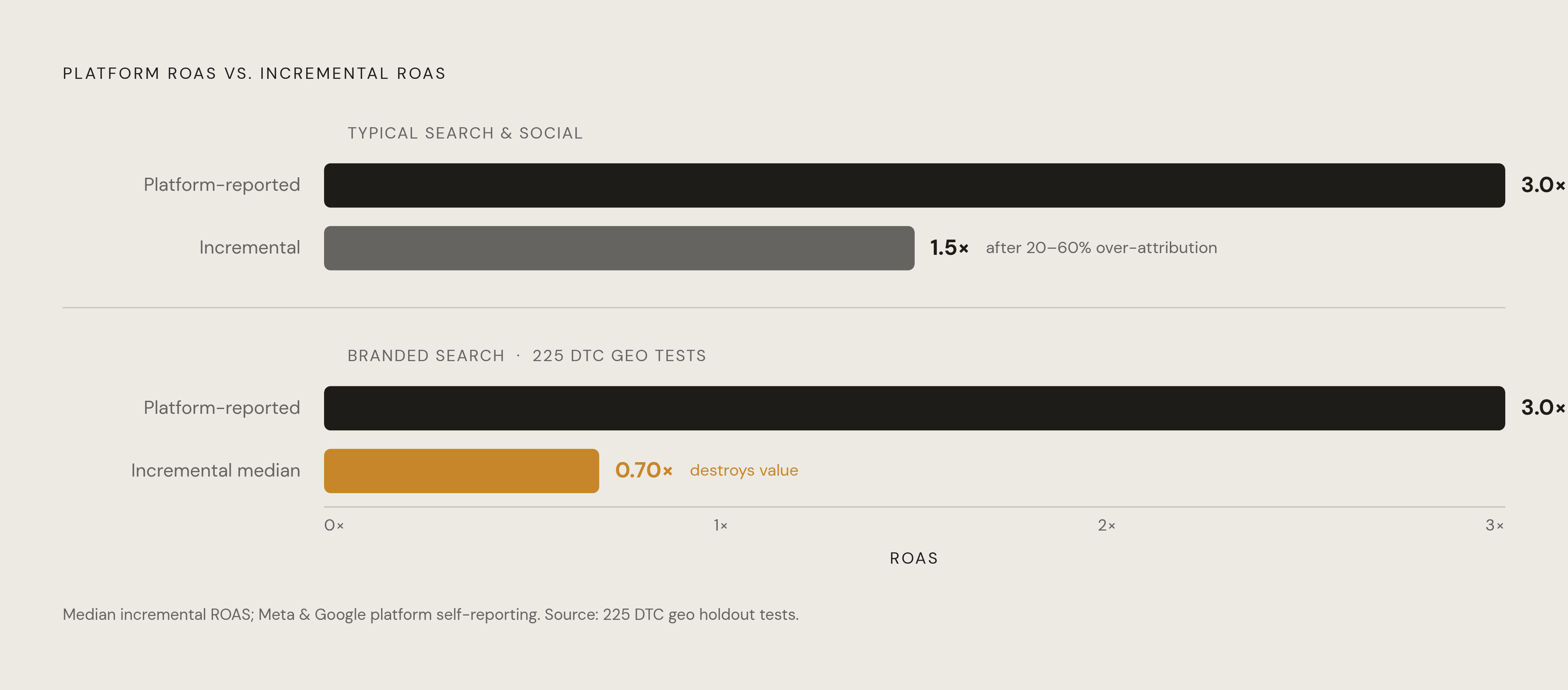
Meta and Google routinely over-attribute by 20 to 60%, which means a campaign showing a tidy 3x return on-platform can turn out to deliver something closer to 1.5x once measured incrementally. That's not a rounding error. It's the difference between a channel that's working and one that's merely well-tracked.
Public case studies from the measurement vendor Haus, covering brands including Bombas, True Classic, and Liquid Death, document overstatement in the 1.5x to 3x range, and the gap is widest precisely on brand search and retargeting, the two channels where the shopper was most likely to buy regardless of whether the ad ran. Branded search is the standout offender. Across one vendor's dataset of 225 DTC geo tests, branded search posted a median incremental ROAS of just 0.70x, the lowest of any channel measured.
The dollar cost of not knowing this is not small. Per Haus's Marketing Decision Confidence Index, 78% of senior US decision-makers believe at least 10% of their marketing spend is wasted because measurement isn't good enough to catch it, and 7% put that figure at 30% or higher.
Retargeting and brand search deserve the first incrementality check any brand runs, precisely because they intercept demand that already exists rather than generating anything new. High conversion rate, low or negative incrementality: that combination is the classic signature of a channel riding on top of decisions shoppers had already made. Upper-funnel channels like connected TV, video, and audio sit at the opposite end of the same problem. Attribution chronically undervalues them because there's no clean last-touch path connecting a TV impression to a purchase three days later, and yet geo-based incrementality testing can reveal real demand those channels create that a dashboard would never show.
The AI angle sharpens all of this. When a shopper's research happens through an agent on ChatGPT, gets filtered through Perplexity, and the shopper arrives at checkout already decided, the retargeting ad that fires on the way to that checkout still gets full credit in the dashboard. It contributed nothing incremental. It just happened to be standing there when the sale closed.
When conversion rate lift is still the right tool
None of this means conversion rate lift belongs in the trash. It's the correct tool for on-site optimization: testing page layouts, testing copy, testing checkout flows, any situation where the question is which version performs better rather than whether a channel created demand that wouldn't otherwise exist.
Lift is also the right language for brand studies measuring awareness, consideration, or favorability, survey-based work that sits upstream of conversion and isn't trying to prove causation on revenue. Scale matters too. Brands with a revenue base too small to run a statistically clean geo holdout typically don't have the spend or traffic volume to support one, so for that tier, last-click tracking on platform pixels paired with server-side event routing is a reasonable starting point rather than a compromise.
The honest framing is this: conversion rate lift tells a brand that something changed. Incrementality tells a brand whether its spend caused the change. Both questions are legitimate, just not interchangeable. The channels where lift misleads hardest are the ones intercepting existing demand, brand search, retargeting, loyalty email, where a strong conversion rate lift number flatters a channel that's arguably not creating anything. The channels where lift undercounts hardest are the ones creating new demand, prospecting video, connected TV, and increasingly, AI discovery surfaces, where the real influence never appears in a last-touch report at all.
A reasonable place to start: pick whichever single channel, branded search or retargeting, shows the widest gap between platform-reported ROAS and plain business intuition, and run the incrementality test there first.
Why AI-assisted shopping journeys break last-touch attribution more completely than anything before them
Agentic commerce describes autonomous AI agents that research, compare, and complete purchases on a consumer's behalf with minimal human input, a meaningfully different thing from traditional ecommerce, which still requires a person to browse and check out manually. The distinction that matters here: a chatbot answers questions, while a shopping agent acts. It interprets context, makes a decision, and takes purposeful action for the shopper, sometimes without the shopper touching a single product page.
Adoption is moving fast. Consumer use of these agents is widely expected to grow sharply over the next two years.
The attribution issue this creates is structural, not incidental. When a shopping agent researches products through ChatGPT, Perplexity, or Google's AI Mode and delivers a shopper to a brand's storefront already decided, that influence leaves no cookie, no click, no referral source that resolves cleanly into any attribution model, last-touch or multi-touch. A growing share of marketing leaders report that these agents have weakened their ability to connect directly with customers, signaling that the discovery layer itself is migrating away from the owned, trackable surfaces brands built their measurement stacks around. In this environment, brands compete for an agent's selection through data quality, protocol compliance, and how complete their product catalog is, not through design or advertising rank, and that competition leaves no trace in any conventional conversion path.
Conversion rate lift, calculated off platform data, simply cannot see any of this. Incrementality testing is structurally more durable here because it compares outcomes between groups rather than trying to reconstruct an attribution chain that AI-mediated discovery has already made invisible; it does not directly measure AI agent influence. That's a meaningful distinction: incrementality testing survives this shift by not depending on the thing that broke.
The measurement infrastructure incrementality requires
Incrementality testing has moved past the experimental stage. Per a TransUnion survey cited by EMARKETER, about 52% of US brand and agency marketers now use incrementality testing in some form, up sharply from a niche practice just two years prior, and 36% plan to increase that investment over the coming year.
The pressure is most visible in retail media. The ANA found that 71% of advertisers now rank incrementality as their single most important KPI, a shift that matters given US retail media spending reached $60.81 billion in 2025, adding roughly $29.2 billion in genuinely new dollars to the ecosystem. Cost has fallen too: Google reports cutting minimum test budgets from around $100,000 down to roughly $5,000 through improvements in Bayesian modeling. That's a vendor-stated number rather than an independently audited one, but directionally it points toward incrementality testing becoming realistic for mid-market brands, not just the largest advertisers.
The tooling has matured to match. Recast launched a standalone GeoLift product in September 2025, built to validate and calibrate marketing mix model outputs against real experiments rather than treating MMM and testing as separate exercises. MMM itself has sped up. Per MiQ, cited in EMARKETER research, marketing mix modeling now runs on one-to-three-month cycles instead of annual ones, which makes it something a mid-market DTC brand can actually act on rather than a once-a-year report that arrives too late to change anything.
Different tiers of brand tend to reach for different tools. Mid-market DTC teams often work with Haus for geo experimentation and causal MMM, or with platforms like WorkMagic, SegmentStream, and Rockerbox, alongside Measured's managed system connecting experiments to MMM. Enterprise teams add LiftLab, which ties experiments to an ongoing budget model, Lifesight, which blends several measurement methods together, and Recast's Bayesian MMM for teams with the analytical maturity to use it well. High-spend DTC brands looking for attribution, MMM, and automated incrementality testing under one roof have turned to Northbeam, built specifically for validation in a post-privacy-change environment. And for context around any of these findings, a consolidated dashboard like Triple Whale, covering MER, ROAS, CAC, and LTV, is useful for interpreting incrementality results rather than replacing the testing itself.
Most tests that fail, fail before they start, and budget is rarely the reason. It's pre-test fit. In one vendor's dataset of 225 DTC geo tests, only a minority met the fit criteria tight enough to produce a clean read, and any setup that misses those thresholds returns an inconclusive result no matter how much money is behind it. Running tests continuously, rather than as one-off events, builds a working knowledge base that informs budget decisions with evidence instead of guesswork, and centralizing that measurement has been shown to cut experiment setup time from around two weeks down to two days.
What honest AI-revenue measurement looks like in practice for DTC brands
Adobe's 2026 figure is the crux of the whole argument: only 7% of marketing teams have embedded AI in ways that deliver measurable business outcomes. The gap between adopting an AI tool and proving it's worth the money is, overwhelmingly, a measurement gap.
The IAB's State of Data report estimates that improvements to advanced measurement could add roughly $26.3 billion in media investment and $6.2 billion in productivity within one to two years, a meaningful number, though IAB chief executive David Cohen said at the report's launch that advanced measurement is "still falling short of its core promise." Those two statements sit together honestly: the upside carries a meaningful productivity gain within one to two years, and the current tooling still isn't delivering it consistently.
For DTC brands trying to measure AI-influenced journeys honestly, a few practices hold up better than others. Measuring on-site AI tools against an engaged-shopper cohort, comparing shoppers who interact with an AI sales layer to those who don't, using the brand's own baseline rather than a platform's self-reported attribution, gives a cleaner read than any dashboard number will. Tracking new-customer acquisition rate and repeat purchase rate separately from overall conversion rate matters too: real incrementality in AI-assisted commerce should appear as more net-new customers, not just a higher conversion rate among shoppers who were already on a purchase path. And when a brand invests in catalog enrichment specifically to improve its visibility inside ChatGPT or Perplexity results, a geo holdout comparing markets where that structured data is live against markets where it's withheld is the only way to know if the investment actually created incremental demand.
Catalog quality functions as a measurement input as much as a marketing one. Structured, accurate product data is what AI shopping agents read and cite when deciding what to recommend. Brands with complete catalogs appear correctly in agent outputs; brands without them get described however a third-party model happens to guess, and that difference eventually appears in incremental traffic and revenue, but only for a brand actually measuring holistically rather than trusting whatever a platform dashboard reports back.
Attribution and incrementality answer different questions. It's how many of those conversions would have happened anyway.
Sources
- Marketing Lift: How to Measure True Campaign Impact (2026)
- Incrementality Testing: Proving Ads Actually Caused Sales
- What Is Incrementality Testing in Marketing Measurement
- How to Measure Incrementality in Marketing Campaigns — AI Digital
- What is incrementality testing? A 2026 guide for DTC operators | Eightx