AI-Influenced Conversions and Attribution Model Gaps
AI-referred shoppers convert 60 percent better, but most brands can't track them.

A shopper's decision to buy something now starts long before they ever land on a brand's website, often inside a conversation with ChatGPT or Perplexity that occurs entirely outside a brand's tracking infrastructure. That shift is quietly breaking the attribution models most direct-to-consumer brands still rely on to decide where their marketing budget goes.
Why the click-through path no longer captures how shoppers decide
Attribution, as most DTC teams practice it, rests on an assumption baked in during the paid-search era: a shopper sees an ad, clicks it, lands on a page, and buys, leaving a clean trail with a first touch and a last touch. That assumption held up fine when paid search and display accounted for most discovery, because nearly every meaningful step left behind a cookie or a click event to follow.
The DTC market this logic runs on is not small or slow-moving. The DTC market was valued at $296.45 billion in 2025 and is on track to hit $319.57 billion in 2026, per industry market data, and a base that size means small measurement errors turn into large budget mistakes fast. Customer acquisition costs have climbed 222% over eight years, and the median DTC site conversion rate is just 1.17% across approximately 17 million sessions. Brands are running on thin margins already. A model that miscounts where sales actually come from is a direct hit to survival at this point. It's a direct hit to survival.
How AI assistants have inserted themselves into the purchase journey before a shopper visits a site
Before a shopper ever opens a brand's URL, there's a decent chance they've already asked ChatGPT, Perplexity, or Google AI Mode to compare features, sanity-check a price, or just point them toward something worth buying. Generative AI use in shopping jumped fast: 38% of consumers reported using it for online shopping in 2024, and that number rose to 51% by 2025, a 34% year-over-year increase.
A Similarweb behavioral study found that consumers who got a brand recommendation from ChatGPT were 2.5x more likely to visit that brand's site within seven days. The AI touchpoint happens off-site, off-pixel, somewhere in a chat window the brand has no visibility into, so most of that lift never appears as an AI referral in the brand's own analytics. That's the blind spot in one sentence: the AI touchpoint happens off-site, off-pixel, somewhere in a chat window the brand has no visibility into, so by the time the shopper lands on-site, they register as organic or direct traffic. Nothing about the visit looks unusual. The influence behind it is invisible.
What the traffic data shows once AI-referred visits are separated from the rest
Pulling AI-referred traffic out of the general pool makes the numbers hard to ignore. Adobe Analytics reported that AI-referred traffic to US retail sites rose 393% year over year in Q1 2026. And this traffic isn't just growing, it's converting well: roughly 42% better than other channels in March 2026, a sharp reversal from March 2025, when AI referrals had actually converted about 38% worse.
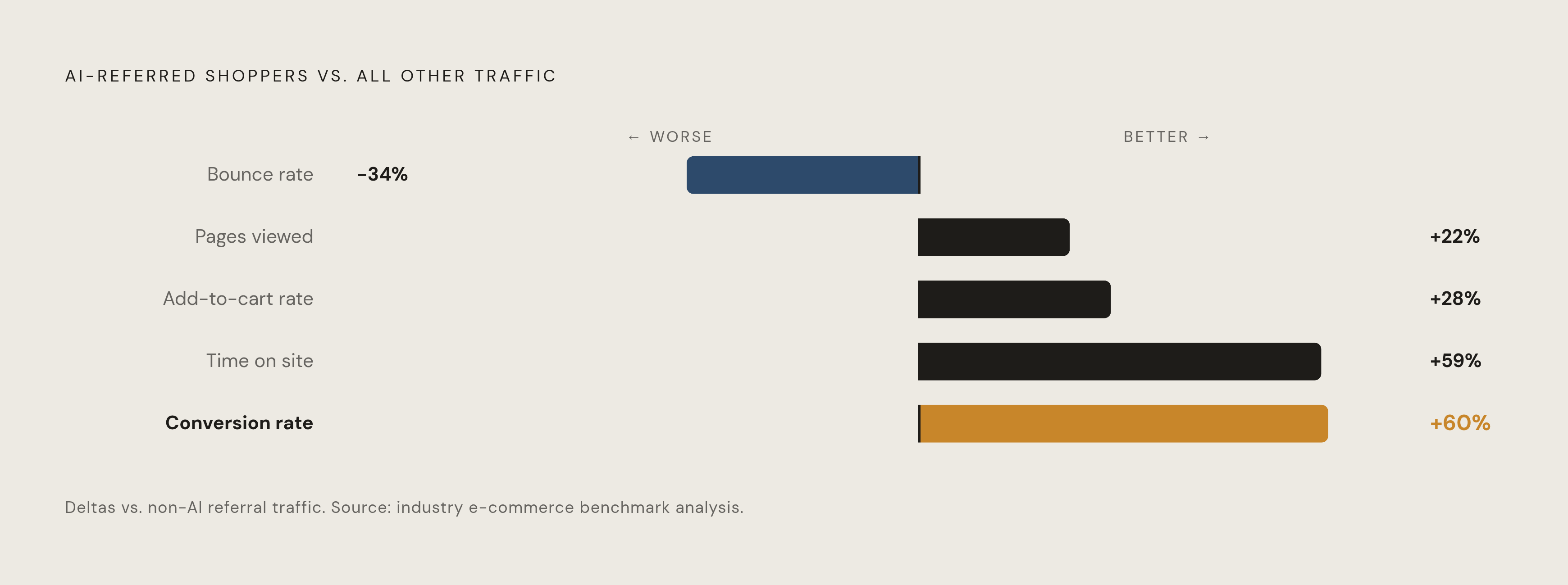
The behavioral gap runs deeper than conversion rate alone. AI-referred shoppers convert 60% higher, spend 59% more time on site, view 22% more pages, add to cart 28% more often, and bounce 34% less than other traffic. This is the best-behaving visitor segment most DTC brands have, and it's simultaneously the segment their attribution stack is least equipped to see or credit correctly.
Why legacy attribution models were structurally unable to handle this even before AI entered the picture
Attribution was already cracking before AI assistants entered the picture. A mobile operating system update requiring apps to ask permission before tracking users cut attribution accuracy across DTC brands by up to 70%, and acquisition costs climbed 19 to 43% across platforms in response. Client-side pixels, meanwhile, miss an estimated 20 to 40% of conversions, thanks to ad blockers, browser-level Intelligent Tracking Prevention (ITP), and consent rejections that quietly opt shoppers out of being tracked.
Signal loss from privacy changes is projected to touch 78% of existing attribution setups by 2026. Layer on top of that the fact that Meta, Google, and TikTok each attribute conversions using their own internal logic, and each one tends to overstate its own contribution. Agency data cited in industry reporting puts the resulting gap between actual conversions and what legacy tracking reports at 67%. AI-influenced traffic is landing on a measurement foundation that was already buckling. It's landing on one that was already buckling.
How full agentic commerce, where the AI doesn't just advise but transacts, breaks attribution further
Agentic commerce takes the problem a step further. Instead of an AI assistant advising a shopper who then goes and buys something themselves, the AI agent discovers the product, evaluates it, authorizes the purchase, and pays, with the human simply setting the parameters up front. The conscious decision points that make up a conventional customer journey collapse into a string of automated micro-decisions that no analytics platform was built to watch.
This isn't theoretical: OpenAI and Stripe launched the Agentic Commerce Protocol on September 29, 2025, with Etsy as the first integrated merchant. OpenAI and Stripe launched the Agentic Commerce Protocol on September 29, 2025, with Etsy as the first integrated merchant, and while Instant Checkout was later retired in March 2026, it was replaced by dedicated retailer apps inside ChatGPT covering Walmart, Target, and Instacart. Shopify announced Agentic Storefronts in December 2025, letting shoppers discover and buy products inside ChatGPT, Perplexity, and Microsoft Copilot, with checkout completing back on the merchant's own storefront. Google's Universal Commerce Protocol launched at NRF in January 2026, the same event where Microsoft Copilot Checkout went live in the US. Visa launched its Visa Intelligent Commerce platform in April 2025. Santander and Mastercard, separately, completed a live end-to-end payment executed by an AI agent, running on Santander's live payments infrastructure alongside Mastercard Agent Pay.
When an agent completes a purchase on a shopper's behalf, that conversion event happens inside ChatGPT, inside Perplexity, or inside a payment protocol, entirely outside the brand's analytics stack. There's no session to log, no page view, no pixel firing anywhere in the chain. Emerging research on agent purchasing behavior also suggests these systems aren't the perfectly rational optimizers economic theory tends to assume. They carry their own biases and quirks, some of them exploitable, some tied to the specific model doing the deciding, and none of it necessarily mirrors the human intent brands have spent years learning to optimize around.
What misattribution costs a DTC brand in budget and competitive position
The gap between what a dashboard reports and what actually happened in the bank account is where this becomes a budget problem rather than a technical curiosity. A platform dashboard showing strong ROAS while revenue growth doesn't follow suit is what happens when last-click attribution, a fragmented cookie landscape, and platform self-reporting collide.
Because AI-influenced conversions tend to arrive on-site labeled as direct, organic, or branded search, credit flows to channels that didn't actually earn it. Paid search and paid social look like they're outperforming. AI, the channel actually shaping the decision, gets nothing. The resulting budget behavior follows the false signal: brands keep over-investing in the channels getting credited and have no data-backed case for spending on AI readiness, catalog enrichment, or on-site AI tools. The channels the dashboard says are winning keep consuming budget. The channel actually driving the sale goes unfunded.
None of this is happening in a market with room to absorb waste. Average DTC customer acquisition cost has risen 40 to 60% over the past two years, Meta CPMs have inflated 15 to 22% across most DTC verticals through 2025, and average ecommerce ROAS now runs around 2.87:1, with Meta often closer to 2.2:1 on cold traffic. Misallocating spend at those margins carries real, compounding costs. A brand that scales and one that doesn't part ways on exactly this.
Measurement approaches that can begin to close the gap
Attribution in 2026 is a layered problem, not the outright crisis some 2023-era predictions expected. It's a layered problem now, one where no single method is sufficient on its own, and brands treating any one of them as the whole answer are setting themselves up to keep guessing.
Last-click still has a job: it's fine for daily budget pacing, where a fast, rough signal beats no signal. Where it fails is when it's treated as the sole basis for larger allocation decisions, especially on branded search and retargeting, where it tends to take credit for demand that already existed. Pairing it with periodic incrementality testing, using geo-holdout or matched-market tests, isolates the actual causal lift of a channel independent of whatever ROAS a platform reports. That's the method that can answer the harder question: would this AI-influenced traffic have converted anyway, or not?
Cohort analysis fills in another piece. Segmenting visitors by behavioral signal, meaning time on site, pages viewed, add-to-cart rate, rather than by referral source alone, picks up AI-shaped intent even when the referral itself gets misclassified. The 59% longer session times and 22% more pages viewed among AI-referred shoppers are detectable in the data long before the labeling catches up.
Why catalog quality and on-site AI readiness determine whether a brand shows up in AI recommendations at all
None of the above matters if an AI agent can't find the product. Agents evaluate merchants programmatically, reading structured data: product attributes, return policies, delivery windows, review counts. A brand with a messy, unstructured, or incomplete catalog is functionally invisible to an agent that has no way to parse what it's looking at.
This is where a newer discipline, sometimes called Answer Engine Optimization, comes in. As commercetools frames it, whether an agent can understand a SKU well enough to recommend it depends on structured data, enriched metadata, and clean catalog information. It sits on top of SEO, not in place of it, and it's already becoming table stakes.
Discovery is the first step in the agent purchase process, without it, the subsequent steps of authorization, payment, and fulfillment never happen. Fail at discovery and the other three steps never happen. There's no conversion event at all to misattribute or correctly attribute. Enriched, structured product data functions less like a marketing nicety here and more like a moat: it's what gets a brand cited and chosen by AI shopping surfaces. Brands with thin or poorly structured catalogs will stay underrepresented in AI recommendations no matter how much they spend on paid media.
What DTC brands should do differently in their attribution and investment decisions starting now
Last-click ROAS pulled from Meta, Google, or TikTok's own dashboards needs to stop functioning as the primary budget signal. Treat it as one input among several, sitting alongside incrementality results and first-party behavioral cohort data, not as the deciding vote.
A practical near-term step is monitoring AI referral sources, ChatGPT, Perplexity, Google AI Mode, as distinct segments within existing analytics workflows. That single step makes the AI-referred fraction of traffic visible without building any new infrastructure. From there, segmenting high-engagement visitors by the behavioral profile tied to AI-shaped intent gives brands a working proxy while more complete attribution gets built out over time.
Catalog enrichment deserves to move up the priority list because it's the precondition for everything else on this list. A brand that is absent from AI recommendations has no AI-influenced conversions to measure, credit, or invest against. Fixing the catalog is the precondition for crediting AI-influenced conversions correctly. It's the first step toward solving it.