Forecasting Seasonal Revenue Swings for DTC Planning
DTC brands must now forecast seasonal demand beyond historical sales data.
Seasonal revenue forecasting for DTC brands now requires a wider view of demand than historical sales and ad spend can provide. As shoppers use AI assistants to weigh products away from storefronts, planners need signals from AI referrals, on-site conversations, and activity in the wider market. Those inputs make inventory, budget, and promotion decisions sharper because they reveal demand before it becomes a familiar click or sale.
Why seasonal revenue forecasting for DTC brands is harder to get right in 2026 than it was three years ago
The traditional seasonal planning model assumes that much of a shopper’s decision process is visible to the brand. Historical sales establish the seasonal baseline, while ad spend curves and click-based traffic patterns help explain how demand develops. That link is harder to trust when shoppers weigh products somewhere the brand cannot see. Forecasting has therefore changed in structure and complexity. A storefront visit increasingly marks the end of consideration.
An AI assistant can evaluate options and route a shopper directly to a product page or complete the transaction inside the chat surface itself. This moves the consideration window out of the storefront and into an AI conversation. A seasonal peak in GA4 may therefore come from choices shoppers have already made in ChatGPT, Perplexity, or Google AI Mode. Google AI Mode makes that shift especially difficult to distinguish because its AI traffic is buried inside Organic Search. The brand sees the resulting visit without seeing the process that produced it.
Salesforce’s 2026 Holiday Predictions frames the coming holiday season as structurally different in its channel mix from prior seasons. As more shoppers use AI-assisted shopping, planners need to account for that change now. The 2026 holiday season will differ materially from 2025’s in the channels driving demand. Historical patterns remain relevant, but their connection to purchase intent is weakening. The inputs forecasters have always relied on are now measuring the wrong moment in the purchase journey.
What AI-referred traffic data is already telling DTC brands about seasonal demand patterns
AI referral traffic already has a seasonal shape that planners can read. AI assistants sent dramatically more traffic to US retail sites year-over-year in Q1 2026, following a prior holiday window that ran at an outsized multiple. That holiday spike makes AI referrals relevant to Q4 planning as well as full-year forecasts. The growing channel’s contribution changes around the periods when inventory and promotional commitments matter most.
Shopify’s Q1 2026 platform data shows that AI-referred shoppers convert at meaningfully higher rates and carry higher average order values than organic search visitors. Shopify also reports that more than half of AI-referred sessions start on product pages, compared to roughly one in five for organic search. This landing pattern fits a journey in which product selection happens before the visit. These shoppers arrive closer to a purchase decision rather than beginning a broad browsing session. Their revenue contribution therefore cannot be forecast from session volume alone.
Shopify’s AI-referred orders grew sharply year-over-year in Q1 2026, though they were still few compared with orders from organic search. That distinction matters because a small channel can still have different economics at the seasonal peak. A forecast that gives every visit the same value will miss differences in conversion and order value. Treating AI-referred revenue as a rounding error can consequently misstate margin and misallocate promotional budget. The planning signal lies in the combination of seasonal volume and revenue per session.
Why current attribution tools misread AI-driven seasonal demand and what to do instead
The signal’s absence from a brand’s channel report does not establish its absence from demand. Attribution tools can classify AI-influenced visits under other channels, leaving reported AI referrals below their actual influence on purchases. Google AI Mode traffic within Organic Search illustrates the problem directly. Measurement discipline requires distinguishing a shopper’s recorded arrival channel from where the product decision took place.
The practical response is to treat identifiable AI referrals as a floor. Before the next planning cycle, brands should group known AI referral domains, including chatgpt.com and perplexity.ai, into their own analytics channel. That creates a consistent measure of the traffic attribution can identify. Brands should also add a “how did you hear about us” post-purchase survey to capture influence that referral reporting misses. Together, these two actions establish a measurable floor and a survey-based estimate of the broader contribution.
During seasonal planning, survey responses should help weight the AI channel’s contribution rather than leaving platform-reported figures as the sole measure. The gap between the two indicates influence that referral attribution is missing, although it does not establish a precise total. This distinction also matters at the product level because AI shopping agents recommend specific products. A product’s presence in AI-generated answers is a leading indicator of which SKUs may drive seasonal revenue. Its absence can leave it invisible in that channel at the peak regardless of ad spend.
How conversational demand data from on-site AI interactions gives brands a pre-season demand signal no ad platform provides
On-site AI conversations provide a different view of demand because shoppers state what they are considering before a purchase enters historical sales data. The brand can collect these signals itself, while off-site AI influence is harder to see. Their value is not primarily a record of service needs. A large share of these conversations comes from shoppers who are deciding what to buy. That makes the content of the conversation relevant to the demand forecast.
Questions about size, material, use case, and availability show which product attributes shoppers are weighing. Sales history can show what sold, but it cannot by itself show what current shoppers are asking before they buy. A surge in requests for “gifts under a set budget” or “gifts that ship by Friday” adds another layer. Those queries show the limits that shape what shoppers intend to buy for the season, as well as the products they end up buying. Their timing can support inventory and promotional adjustments weeks before the shift appears in sales data.
Tracking how many conversations take place and what they cover each week turns shoppers’ questions into a demand curve for the weeks ahead. The useful distinction is between how much purchase-stage interest exists and what that interest concerns. A rise in one category’s questions carries a different planning meaning from a change in the attributes shoppers ask about. Both can sharpen the view of approaching demand without being treated as completed orders.
How AI agents processing competitor pricing and social signals ahead of a seasonal peak can sharpen inventory forecasts
Demand can also change outside both the brand’s storefront and its AI referral stream. Competitor pricing, social sentiment, and category-level velocity can show a seasonal shift before it is visible in the brand’s sales history. AI agents that monitor these inputs give planners a lead time advantage over approaches anchored to internal spreadsheets. The forecasting value comes from connecting external movement with the brand’s commercial position. Monitoring does less to help the forecast when its signals stay separate from sales, acquisition costs, and inventory velocity.
A DTC apparel brand with approximately $520k/month in revenue made that link with an inventory system that used three agents. Agent A, the Scout, monitored competitor pricing and social mentions of the brand’s core category in real time. Agent B, the Analyst, brought Shopify sales data and ad spend together to work out real-time cost-per-acquisition and compare it with inventory velocity. Agent C, the Executor, drafted purchase orders every Tuesday using a 45-day rolling forecast plus a “viral risk” score.
The “viral risk” score addresses a demand pattern that a smooth seasonal curve can miss. A shopping agent’s mention or a viral post can wipe out weeks of stock in hours, making the signal before the sale especially important. By the time the stockout is recorded in sales and inventory records, it is too late for a warning to help. In this system, agents drafted purchase orders that required human approval before spend was committed. That guardrail preserved judgment over seasonal commitments while automating signal monitoring and the draft logic.
What a seasonal forecasting model looks like when it incorporates all four signal types together
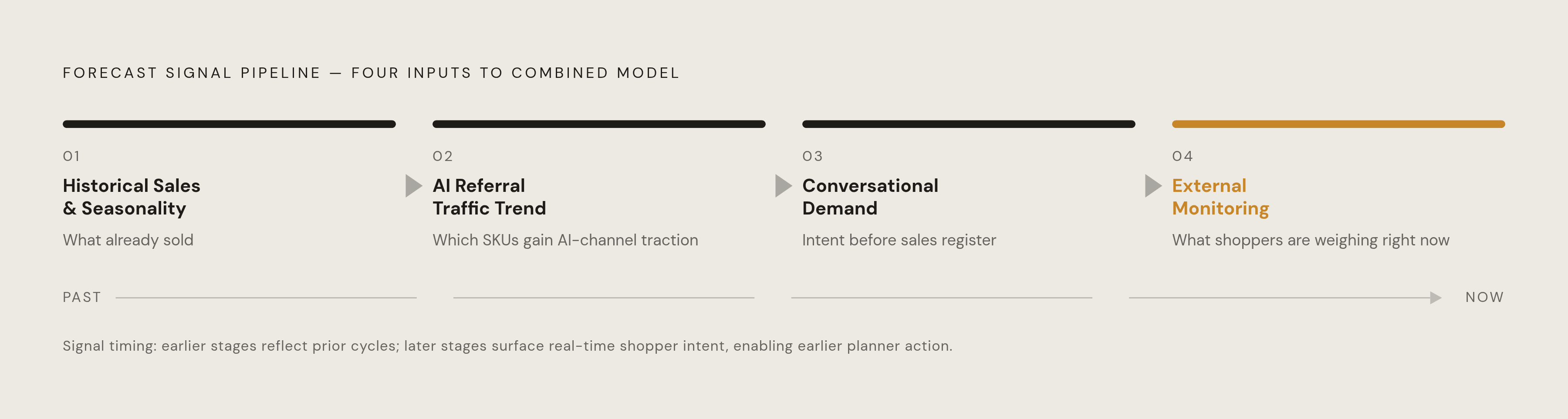
The combined model begins with historical sales and a seasonality index. These remain the anchor for established SKUs with sufficient months of clean data, rather than inputs to discard because discovery has changed. Exponential smoothing and regression analysis remain valid quantitative techniques for stable products. The baseline establishes the demand curve that later signals may qualify. Its role is to describe the established pattern without assuming that the next peak will follow the same discovery path.
The next input is the AI referral traffic trend, measured through the distinct channel of known AI domains. At the SKU level, this shows which products are gaining identifiable AI-channel traction ahead of the peak and which are not appearing. Post-purchase survey data then helps planners place that measured floor within a wider estimate of how much demand AI has shaped. This step separates directly attributed activity from demand that may have been shaped earlier in an assistant’s conversation. It also keeps the higher revenue per session in view when traffic from different channels is grouped together.
Conversational demand adds how the number and topics of on-site AI interactions change from week to week. These trends identify the use cases and product attributes entering consideration before sales register the outcome. External monitoring then adds competitor pricing, social sentiment, and category velocity to inform safety stock and draft purchase orders. Each input captures a different moment or pressure in the purchase journey. Their value comes from that difference.
Most DTC brands refresh forecasts monthly and make weekly adjustments during peaks. The AI-era inputs change what feeds each adjustment. The monthly baseline remains grounded in sales history, while weekly revisions can reflect AI-channel traction, stated shopper intent, and external demand shifts. This gives planners a concrete way to bring earlier signals into inventory, budget, and promotional decisions. The resulting demand curve is sharper, though some seasonal movements remain unpredictable.
Where the model breaks down and what honest planners should expect from AI-era seasonal forecasting
The combined model introduces uncertainty as well as information. Research presented at the ACM Web Conference 2026 found systematic biases in how AI agents buy products in e-commerce settings. Agent-mediated traffic may therefore fail to represent the broader customer population. Agents may also act differently in peak season than they usually do, in ways that past agent-traffic data cannot yet predict.
Attribution remains another limit even after AI-domain segmentation and post-purchase surveys are in place. The measured referral floor is observable, but the true share of revenue influenced by AI assistants remains an estimate. Survey responses broaden the view without turning it into a definitive ceiling. Planners should therefore treat the combined figure as directional and size seasonal budgets with a range.
That distinction sets the proper expectation for AI-era forecasting. Historical sales still show established demand, while the newer inputs show what shoppers are weighing and how the market is changing beyond what click-based models can see. Those signals belong in a structured planning process that preserves human judgment over major commitments. Brands building these habits now will plan with sharper precision than those still anchored to click-based patterns. They will also hold a seasonal forecasting advantage over competitors who wait until AI-channel volume is too large to ignore.