Last-Click Attribution Failures in Multi-Touch DTC Journeys
Platforms claim last-click credit they didn't earn.

Last-click attribution systematically mismeasures multi-touch DTC journeys by rewarding the final click while erasing every upstream touchpoint that drove the decision, leading brands to overfund retargeting and starve the discovery channels doing the actual work of building demand. Getting specific about where and why the model fails is the starting point for building measurement that actually reflects how people shop.
Why last-click became the default
Marketers picked last-click for a simple reason: it gives one channel the win, and a single number is easy to defend in a budget meeting.
That simplicity had a real technical foundation once. Redirect-based tracking sent the user through a measurement partner's server on the way to the destination, which meant an independent party stamped the click with a verifiable timestamp before handing the shopper off. An independent party stamped the click with a verifiable timestamp before handing the shopper off, so "last click" meant something concrete.
That infrastructure doesn't exist anymore in most of the ad ecosystem. Platforms moved to redirect-less tracking for speed and privacy, which means the platform reporting the click is also the platform grading its own homework, self-reporting the timestamp with no outside party checking the math. A "last click" claim today is often just that: a claim.
Credit determines budget, and budget determines who gets paid. Research presented at NeurIPS found that platforms have a built-in incentive to time their conversion reports so they land last in the sequence, a form of manipulation the researchers describe as feasible and, under the infrastructure most brands run today, close to impossible to catch. Nobody has to prove intent for this to be a problem. The incentive alone is enough to distort the numbers.
What last-click does to channel credit, and by how much
The distortion isn't a rounding error. Last-click overstates the contribution of paid search by 40 to 65%, while it understates display by 200 to 400% and content marketing by 150 to 300% https://www.xictron.com/en/blog/marketing-attribution-multi-touch-2026/. Those aren't close numbers. A channel that's actually driving a fraction of outcomes can appear in the dashboard as the hero of the whole campaign, while the channels that built the case for buying in the first place look like dead weight.
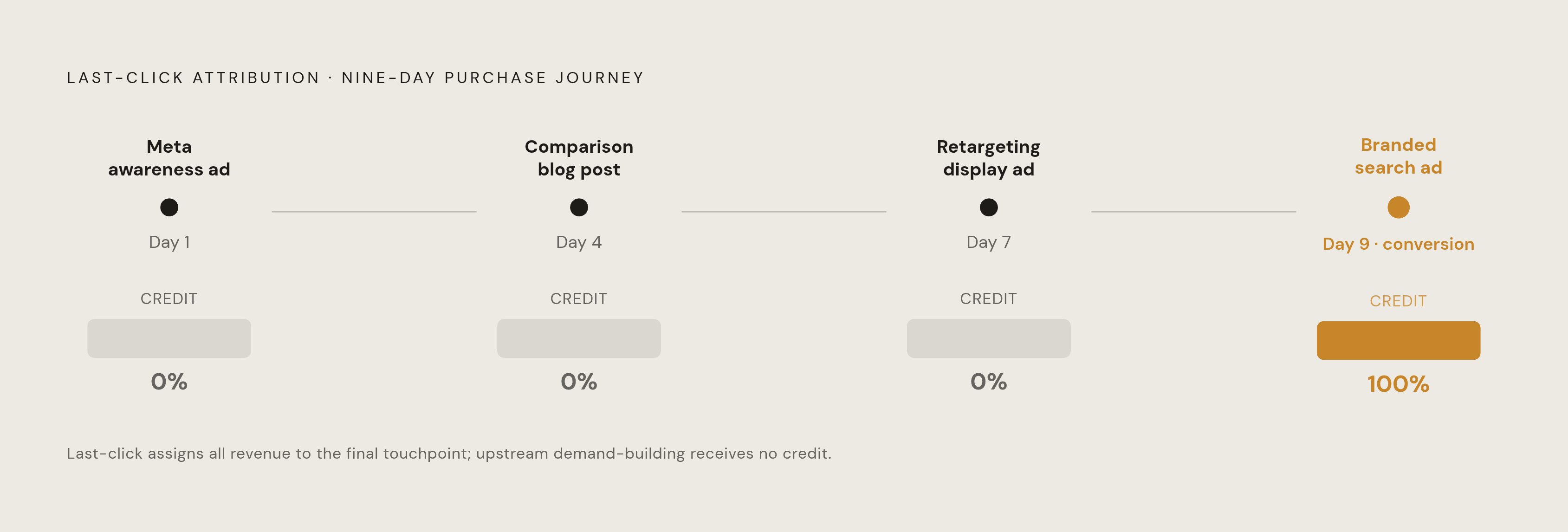
Walk a real journey through the math. A shopper sees a Meta awareness ad, reads an organic comparison blog, gets served a retargeting display ad, and finally clicks a branded search ad and buys, in a Day 1–9 journey. Under last-click, the branded search ad gets all the revenue. The Meta ad, the blog post, and the retargeting display all receive zero credit, while branded search receives everything, even though branded search only works as well as the demand those earlier touchpoints built.
This produces a genuinely circular trap. Teams that steer budget by last-click performance end up cutting the channels that make last-click performance possible in the first place, since paid search is often just harvesting demand that display, social, and content generated upstream, and last-click makes that upstream contribution structurally invisible. Cutting the awareness spend eventually causes branded search volume to fall too, but the dashboard won't tell you why. It'll just look like search got worse.
Switching to a different rule-based model doesn't fully solve this, either. First-touch swings too far the other way, giving 100% of the credit to an ad a shopper might have scrolled past and ignored for two weeks before actually deciding to buy. Linear attribution treats that same brand exposure as equal in value to the final retargeting click that closed the sale, which flattens a journey that wasn't actually flat. Time-decay, weighted with something like a seven-day half-life, tends to fit the short purchase cycles typical of DTC better than any model that hands credit to a single moment. It's not perfect. But it's a meaningfully closer approximation of how attention actually decays over a nine-day buying window.
How privacy changes and cross-device behavior broke last-click's data supply
Apple's iOS 14.5 update eliminated 60 to 70% of Facebook's attribution accuracy, and it did so right as DTC acquisition costs were at record highs, which meant brands lost visibility into paid social exactly when they most needed to know what was working https://www.xictron.com/en/blog/marketing-attribution-multi-touch-2026/.
That wasn't an isolated event. It was one piece of a broader pullback across browsers. Safari began blocking third-party cookies by default back in 2020. Firefox confines cookies to the site that set them. iOS now requires explicit user permission before any app can track activity across other apps. Chrome's decision in April 2025 to keep third-party cookies alive didn't rescue cross-site tracking the way some brands hoped, because the rest of the browser market had already left that model behind.
The signal loss differs depending on the channel. Paid social under the iOS 14.5 consent regime typically shows a gap of 40 to 60% between modeled and observed conversions https://www.xictron.com/en/blog/marketing-attribution-multi-touch-2026/. A large share of the people a brand is trying to track have opted out of being tracked, and the attribution model has to guess at what they did.
Cross-device behavior adds a second layer of distortion on top of the consent gap that comes from opt-outs and privacy restrictions. A shopper who researches a product on their phone and then buys it later from a laptop doesn't look like one customer taking two steps. Last-click systems record two separate users: one who "bounced" on mobile, and one who converted via "direct" traffic on desktop. The mobile research session, the one that actually did the convincing, gets zero credit and likely gets logged as a failed visit. The shopper who was already sold gets misfiled as a stranger who wandered in fresh.
GA4's silent last-click fallback and low-volume DTC brands' exposure to it
Google's own analytics platform illustrates how deep this problem runs. Brands that wanted to compare a spread of models lost that ability in one update.
The default causes a quieter, bigger issue. Fall short of that volume, and GA4 reverts to last-click attribution automatically, with no warning banner, no flag, nothing in the interface that tells the marketer that the model change caused the number they now see.
This hits the majority of the DTC market directly. Most DTC brands running fewer than 400 conversions are not actually using data-driven attribution (they are using last-click under a different label). A founder checking "Model: Data-Driven" in the dropdown has no way of knowing, from that screen alone, whether DDA produced the number or a silent fallback did.
Even brands that clear the threshold aren't fully in the clear. GA4's data-driven model can return results that are functionally identical to last-click under certain data conditions, even when the conversion volume requirement is met. Hitting the volume floor is necessary. It's not sufficient, and treating the DDA label as a guarantee of genuine multi-touch credit is its own kind of mistake.
Platform self-reporting and the ROAS gap that doesn't show up in the bank account
Every DTC founder eventually runs into the same disconnect: the dashboards show strong return on ad spend across every channel, and the bank balance still doesn't grow the way that math would predict. That gap has a name and a rough size.
The reason is structural. Adding up the ROAS claimed by every channel individually produces a total that will almost always exceed the revenue the business actually generated. That's not a bug anyone is going to fix from inside a single platform's dashboard, because no single platform has an incentive to shrink its own reported number.
The NeurIPS 2025 research gives this a sharper theoretical edge. Last-click isn't just an imprecise measurement, it fails a specific test economists use to judge whether a mechanism is trustworthy, known as dominant-strategy incentive compatibility, or DSIC. A mechanism that isn't DSIC means the parties involved have a real structural incentive to game the reporting, in this case by strategically delaying when a platform reports its conversion timestamp so that it lands last in the sequence and claims the credit. That's a mechanism-design flaw: the incentive to distort the numbers is baked into how the system is built. Platform self-reporting has created a persistent ROAS gap that doesn't appear in the bank account: in 2026, per-channel ROAS overstates true return by approximately 2.3×, and a 20–40% variance between Meta Ads Manager and GA4 is now standard.
Agentic commerce's new attribution blind spot
A newer problem is compounding the old one. Agentic commerce moves the purchase decision itself into an AI chat interface: a shopper tells an agent to find trail-running shoes under $150 that arrive by Friday, and the agent compares options and completes the purchase without the shopper ever landing on the brand's own site.
The scale of this shift moved fast. Adobe Analytics measured a 4,700% year-over-year jump in generative-AI-driven traffic to US retail sites between July 2024 and July 2025, and AI-driven orders increased 15-fold across 2025 alone https://www.xictron.com/en/blog/marketing-attribution-multi-touch-2026/. Cyber Week 2025 gives a concrete snapshot: an estimated $14.2 billion in global online sales were driven by generative AI and agents, approximately $3 billion in US Black Friday online sales were attributed to AI agents, and roughly 20% of all global online orders during Cyber Week were AI-influenced https://www.xictron.com/en/blog/marketing-attribution-multi-touch-2026/.
None of that activity appears in a standard attribution stack. When a purchase happens inside an AI surface instead of on the brand's own storefront, it exits the funnel entirely: there's no UTM parameter, no pixel fire, no event log, no email capture, no attribution window to even assign credit within. A brand could be winning a meaningful and expanding share of its sales through agentic surfaces and have literally nothing in its reporting to show for it, which makes the case for investing further in that channel almost impossible to build internally.
What the measurement stack needs to look like to reflect how DTC customers buy
Before touching which model to use, the identity graph itself needs to hold up. No attribution model, rule-based or algorithmic, means much if match rates fall below roughly 60%, because that level of fragmentation scatters real customer journeys across "ghost" users the system can't stitch back together. Fixing collection has to come before trusting any output the model produces, no matter how sophisticated the model claims to be.
Server-side tracking is the practical floor for that fix. Server-side tracking is a partial fix at best. It's the baseline every DTC brand needs in place before any attribution model is worth trusting.
For brands sitting below GA4's 300-to-400 conversion threshold, chasing data-driven attribution is largely a waste of effort, since the platform will just quietly hand back last-click anyway. Time-decay attribution with a roughly seven-day half-life fits the short purchase cycles typical of DTC better than last-click does, because recent touchpoints tend to predict purchase intent more reliably than early awareness, particularly for impulse categories, and the model has the advantage of being auditable by hand with no minimum volume requirement attached.
None of this replaces the need for a causal layer sitting on top. Incrementality testing measures how much additional revenue a channel actually generated, net of what would have happened anyway without that spend, which is a fundamentally different question than "which channel got the last click." Confidence in the industry has been shifting in that direction: a survey found only 39% of marketers still named multi-touch attribution as their most-trusted measurement approach, a sign that trust is migrating toward methods that test causation directly rather than infer it from a sequence of touchpoints https://www.xictron.com/en/blog/marketing-attribution-multi-touch-2026/.
Catalog quality and structured data as the attribution-adjacent problem brands are not tracking
There's a second, quieter measurement gap sitting just upstream of attribution: whether AI systems can find and cite a brand's products at all. ChatGPT doesn't select products the way Google ranks pages. It leans heavily on authoritative list mentions, which account for 41% of its recommendations, followed by awards at 18% and review volume at 16% https://www.xictron.com/en/blog/marketing-attribution-multi-touch-2026/. Domain authority, the metric DTC brands spent a decade building for SEO, isn't what determines which SKU gets surfaced in that context. Structured data is.
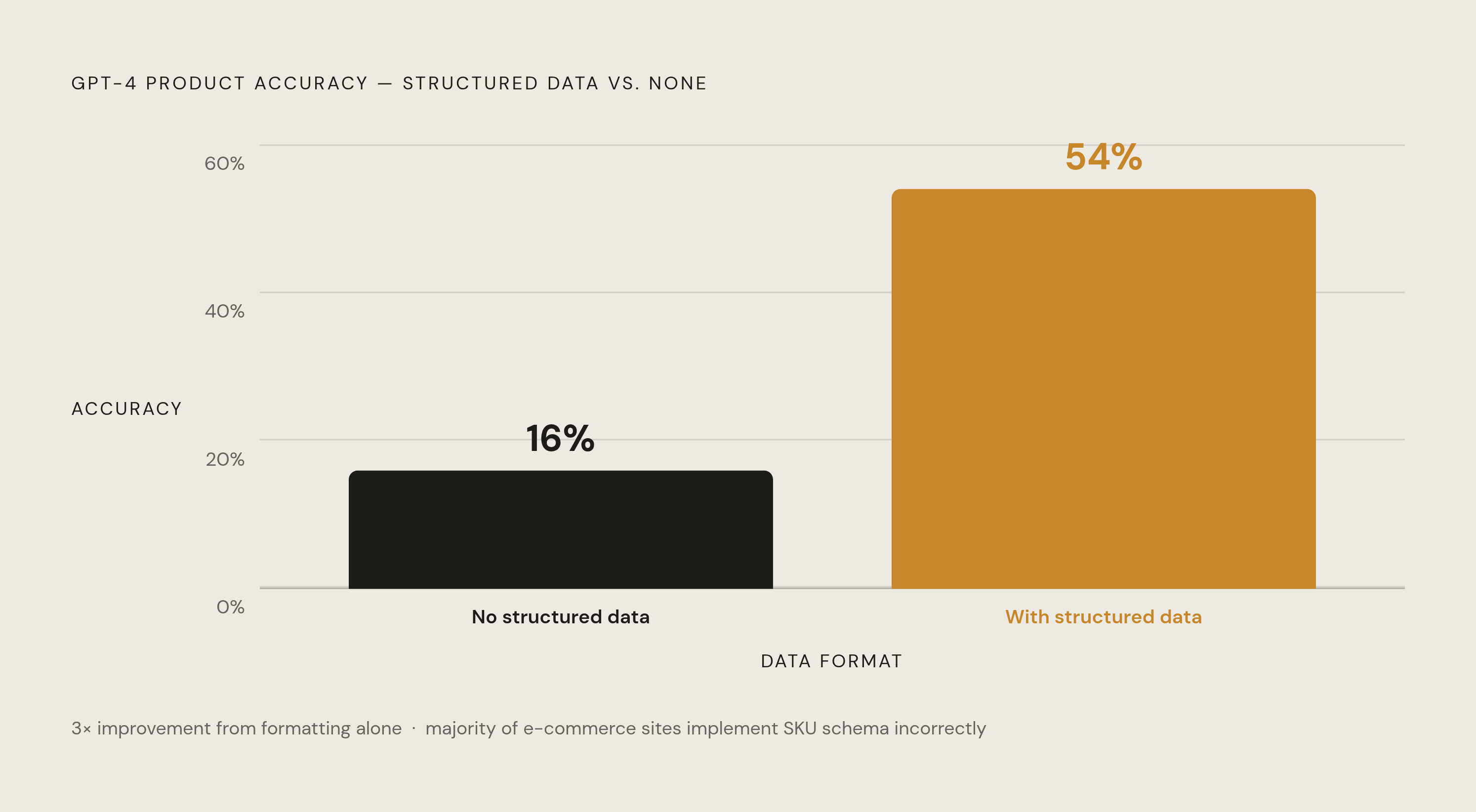
The size of that gap is stark. One study found GPT-4's accuracy in describing a product jumped from 16% to 54% correct responses once the underlying content used proper structured data, a roughly threefold improvement that came from formatting alone, with nothing else about the product changing. Despite this, the large majority of e-commerce sites currently implement SKU schema incorrectly, missing out on the roughly 3× accuracy jump structured data can bring to AI selection.
The consequence is a split between two forms of visibility that used to move together. Audit data shows more than half of brands that rank well on Google aren't cited by AI systems at all, which means the SEO authority a brand spent years accumulating doesn't automatically carry over into whether an AI agent recommends its products. The traffic is thinning out. What's left of it is worth more per visit, which is its own kind of signal about where the value in DTC discovery is actually migrating. Traffic compression is hitting smaller DTC brands hardest, with sites under $10M in revenue losing a large share of organic traffic and mid-market sites losing a significant portion, as the click-to-your-site model that fueled DTC compresses while AI-referred sessions carry a meaningful AOV premium. Per-channel ROAS overstates true return by approximately 2.3× https://www.xictron.com/en/blog/marketing-attribution-multi-touch-2026/. Cookie deprecation is expected to break 78% of existing attribution setups https://www.xictron.com/en/blog/marketing-attribution-multi-touch-2026/. Median DTC contribution margin was 35% in 2021 https://www.xictron.com/en/blog/marketing-attribution-multi-touch-2026/. Median DTC contribution margin fell to 22% in 2025 https://www.xictron.com/en/blog/marketing-attribution-multi-touch-2026/. A 20–40% variance between Meta Ads Manager and GA4 is now standard https://www.xictron.com/en/blog/marketing-attribution-multi-touch-2026/. GA4's data-driven attribution model requires 300–400 monthly conversions per conversion action to function accurately https://www.xictron.com/en/blog/marketing-attribution-multi-touch-2026/. Server-side tracking implementations can recover 15–25% of lost signal from paid social https://www.xictron.com/en/blog/marketing-attribution-multi-touch-2026/. Meta Conversion API implementation shows an average −13% CPR compared to pixel-only tracking https://www.xictron.com/en/blog/marketing-attribution-multi-touch-2026/. Meta Conversion API implementation shows +19% conversions compared to pixel-only tracking https://www.xictron.com/en/blog/marketing-attribution-multi-touch-2026/. Brands using advanced cross-channel attribution are achieving 35–50% better ROAS compared to those relying on platform-native reporting https://www.xictron.com/en/blog/marketing-attribution-multi-touch-2026/. Modern MMM tools claim an average 6.5% annual sales lift through smarter spend allocation https://www.xictron.com/en/blog/marketing-attribution-multi-touch-2026/. Conversion rate is the top KPI shifting from visibility to profitability, cited by 75% of respondents https://www.xictron.com/en/blog/marketing-attribution-multi-touch-2026/. Customer acquisition cost is tracked by 63% of DTC brands as a profitability-focused KPI https://www.xictron.com/en/blog/marketing-attribution-multi-touch-2026/. Customer lifetime value is tracked by 54% of DTC brands as a profitability-focused KPI https://www.xictron.com/en/blog/marketing-attribution-multi-touch-2026/. Average order value is tracked by 50% of DTC brands as a profitability-focused KPI https://www.xictron.com/en/blog/marketing-attribution-multi-touch-2026/. As of January 23, 2026, ChatGPT announced a 4% fee for sales https://www.xictron.com/en/blog/marketing-attribution-multi-touch-2026/. Conversion rates inside ChatGPT were three times lower than when users clicked through to Walmart's own site https://www.xictron.com/en/blog/marketing-attribution-multi-touch-2026/. McKinsey estimates the global agentic commerce opportunity could reach $3 trillion to $5 trillion by 2030 https://www.xictron.com/en/blog/marketing-attribution-multi-touch-2026/.