Marketing Mix Modeling Feasibility for Sub-50M DTC Brands
Shrinking margins and broken attribution make MMM feasible for smaller DTC brands now.

Median DTC contribution margin fell from 35% in 2021 to 22% in 2025, a collapse that changes what a bad measurement decision costs LayerFive Attn Agency. That collapse changes what a bad measurement decision costs. When margins were thick, misreading a channel's real return was an inconvenience.
The timing makes it worse. Average ecommerce ROAS dropped to 2.87:1 in 2025, and Meta CPMs climbed 15 to 22 percent across most verticals in the same stretch LayerFive Segwise. Media got more expensive right as the return on that media got thinner, so the cost of guessing wrong on channel allocation rose on both sides of the ledger at once LayerFive Segwise.
And the guessing is happening on numbers that were never built to be trusted in the first place. Platform-reported ROAS overstates true return by roughly 2.3x: the dashboard a media buyer checks every morning is, on average, telling a story that the bank account will not confirm LayerFive.
Cookie deprecation is an active disruption happening now, not a looming threat to plan around. It's expected to break 78% of existing attribution setups outright: the infrastructure most brands built their entire measurement stack on top of is degrading in real time, not at some point down the road. Meanwhile the internal audience for these numbers has changed too.
Put those threads together and the tension is plain: brands need sharper answers right when the tools that used to supply those answers have gotten less dependable. A brand at scale can absorb a bad quarter of misallocated spend. A brand still finding its footing cannot. A 20–40% variance between Meta Ads Manager and GA4 is now standard, with operators making budget calls on figures that disagree with each other by that margin. The KPI mix is shifting from visibility to profitability: per the State of DTC Marketing Report, the top metrics are conversion rate (75%), CAC (63%), CLV (54%), and AOV (50%), and the CFO is now in the measurement conversation, which raises the bar for credibility Envive Shopify NudgeNow Ecorpit.
MMM's function and survival of the iOS-era attribution collapse
Marketing mix modeling works on a different layer of data entirely. It ingests aggregated weekly or daily time series, spend by channel, total sales, promotional calendars, seasonality, with no user-level IDs, no pixels, and no cookies anywhere in the pipeline. The model reads what the bank account already sees. It doesn't need to know which browser clicked which ad; it needs to know how much went out the door on each channel and how much came back in revenue that week.
Two mathematical ideas do most of the work. Adstock captures the fact that an ad's effect doesn't land entirely in the week it ran; it decays over subsequent weeks. Together, these transforms produce response curves that show marginal ROI by channel LayerFive Segwise.
The output itself is a posterior distribution. MMM hands back a range with uncertainty bands attached.
MMM feasibility for sub-$50M DTC brands is a spend-band decision, with each tier mapped from brands too small to benefit to those where MMM is clearly justified, so operators know which measurement approach fits their current size and data maturity. A Haus 2025 industry survey found that only 39% of marketers named multi-touch attribution as their most-trusted measurement method, showing that confidence has visibly shifted.
The emerging 2026 consensus, drawn from Recast, Haus, Measured, Northbeam, and Prescient AI, arranges the tools into a hierarchy rather than a horse race: MMM sets strategic budget allocation, incrementality experiments calibrate the model's assumptions, and MTA is demoted to tactical, in-channel optimization, tuning which creative or audience performs best inside a channel MMM has already funded. Running MMM by itself, without incrementality tests to check it, ranks as the second-most-common mistake brands make with the method. Neither replaces the other. MMM's outputs are probabilistic by design and need incrementality tests to validate them; treating a model as an oracle that ends the conversation is a misuse of what it's built to do. MMM shows structural immunity to ATT and cookie loss: because it never relied on user-level tracking, the post-iOS degradation that broke MTA does not affect MMM's inputs. Contrasting MMM vs. MTA on the dimensions that matter for operators: data level (aggregated vs. user-level), strength (budget strategy vs. campaign tactics), and history needed (18–24 months vs. near real-time) Eightx.
Why the traditional $50M revenue threshold no longer defines the entry point
That threshold wasn't arbitrary. It reflected what modeling actually cost and how much statistical expertise it demanded, and below that line, the math rarely penciled out.
Three forces pulled that floor out from under the industry. Google's open-source releases, Meridian and LightweightMMM, brought the cash cost of running a model down to zero, and a junior analyst with clean data can now stand up a working model in weeks rather than months.
The demand side backs this up. More than half of US marketers, 53.5%, already use MMM in some form, which puts it well past the point of being a specialist's tool reserved for teams with a dedicated data science function Ranktracker.
The outcome data gives the shift some teeth. Deloitte found that leaders who prioritized MMM were more than twice as likely to beat their revenue goals by 10% or more Braze. Hosted small-brand tools run roughly $500–$3,000/month, and the time-to-first-model has compressed from months to weeks for technically ready teams, per ranktracker.com Eightx Sellforte. Ranktracker.com reports that search interest in media mix modeling jumped over 200% in mid-2025, with the new wave being DTC apparel and regional retail, not Fortune 500s that already had MMM.
It is. A brand needs enough spend volume and enough historical data for a model to produce signal instead of noise. That's a spend-band question, not a revenue question, and it's where the framework below picks up. Most ecommerce brands historically started their MMM journey around $50M in revenue, per sellforte.com, which was the traditional threshold, driven by cost and complexity Ecorpit. SaaS MMM platforms now serve mid-market DTC brands spending as little as $20K–$50K/month on ads, per mediamixmodel.com Eightx Sellforte Ecorpit.
The four spend bands and their implications for brand operators
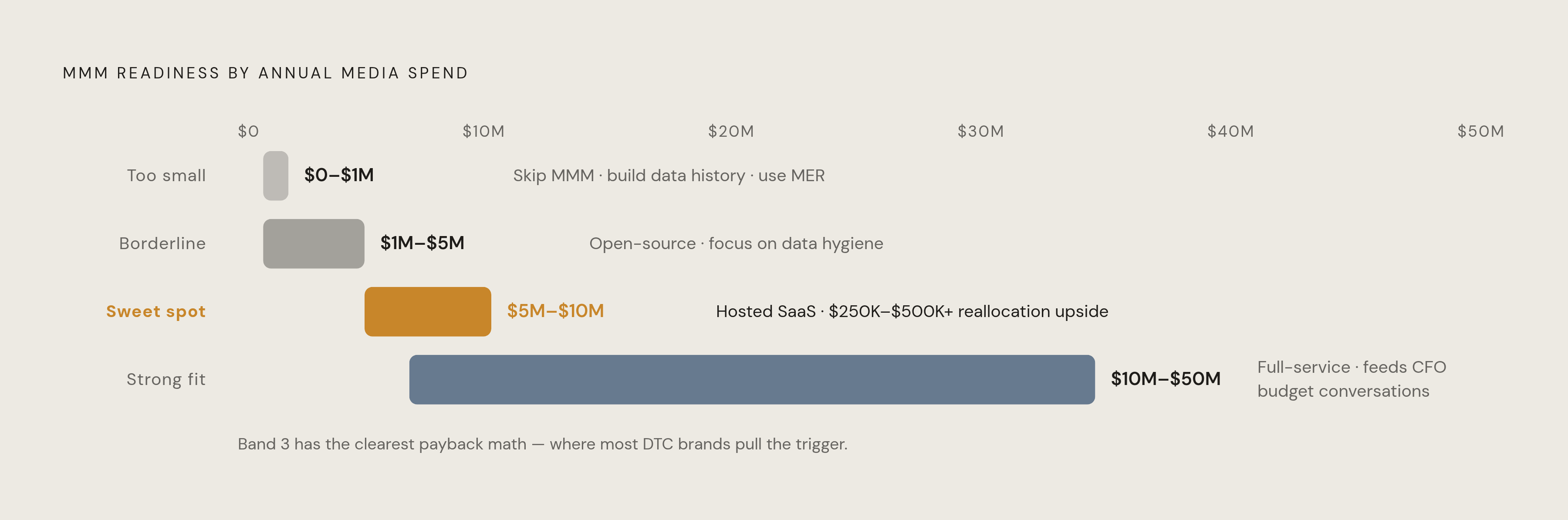
The bands that follow are defined by annual media spend, not revenue, because spend volume and channel count are the direct inputs a model needs to find pattern in the data.
The consensus from Improvado, Prescient AI, and Recast recommends platform reporting paired with quarterly incrementality tests, run as geo-splits or audience-splits, as the right stack. Skip MMM entirely for now, and put the budget instead into cleaning first-party data and building the historical record a model will eventually need. Marketing Efficiency Ratio, total revenue divided by total ad spend, is a serviceable single metric at this stage and doesn't require any sophisticated tooling to calculate or track. Band 4, Strong fit ($10M–$50M annual media spend). Full-service providers (Measured, Sellforte) or hybrid MMM+incrementality platforms are appropriate, and multi-geo or offline-channel configurations push annual cost above the base SaaS range.
Open-source tools, Google's LightweightMMM in Python and Meta's Robyn in R, are the appropriate entry point: zero cash cost, but real analyst labor behind them, and teams without a data scientist on staff are better off waiting or reaching for a hosted entry-level tool instead. The priority at this band is fixing data cleanliness before touching a model at all; server-side tracking and unified conversion streams close the "garbage in, garbage out" gap that would otherwise sink the whole exercise. That hygiene problem runs deeper than the ad spend ledger, too. Research shows 27% of SKUs fail on completeness alone, so the product catalog itself often needs cleanup before a brand's data can support any modeling effort NudgeNow. Open-source tools are the appropriate entry point here, with $0 cash cost but meaningful analyst labor; teams without a data scientist should wait or use a hosted entry-level tool. This is the common DTC adoption zone, where most brands actually pull the trigger on MMM, per eightx.co. On the payback math: at $5M/year in spend, reallocating 5–10% from low- to high-ROI channels based on MMM unlocks $250K–$500K+/year in incremental contribution, which easily covers a SaaS MMM contract running $30K–$80K/year, per eightx.co Braze.
Hosted SaaS platforms such as Recast, Measured, and Sellforte fit naturally for brands in this range, since they iterate faster than a DIY build and don't require standing up a full data science function. Brands running advanced cross-channel attribution at this spend level report 35 to 50% better ROAS than brands still relying on platform-native reporting, and vendors in this space claim an average 6.5% annual sales lift from smarter allocation, a figure worth pressure-testing against each vendor's own methodology but directionally credible at this scale Attn Agency Envive Shopify Segwise. Data volume is approaching viability but results are sensitive to data quality, with 18–24 months of clean weekly history across 3–5+ channels being the prerequisite, per eightx.co. Band 3, Sweet spot ($5M–$10M annual media spend).
This is also where offline channels, Connected TV, out-of-home, podcast advertising, tend to enter the media mix, and MMM's channel-agnostic, aggregated approach becomes especially valuable, since multi-touch attribution typically can't measure these channels at all, though some platforms extend MTA to CTV and podcast through pixel tagging or exposure file matching. Slingwave, unveiled at CES in January 2026, is a newer entrant in this band: it delivers incrementality insights in days rather than months across Amazon, Google, Meta, TikTok, and omnichannel media, combining Bayesian MMM+, agile marketing attribution, and experimentation with a scenario-intelligence layer. Model output has stopped being a marketing team's internal tool and now feeds directly into CFO-level budget conversations because the measurement stack itself has become a competitive advantage at this scale, not just an analytical exercise. Band 1, Too small ($0–$1M annual media spend). Band 2, Borderline ($1M–$5M annual media spend).
The data prerequisites that determine whether a brand is ready within its band
Spend band alone doesn't determine readiness.
"Clean" is doing a lot of work in that sentence, and it means something specific. Channel naming has to stay consistent across the full history; rename a channel partway through the year and the time series breaks in a way the model can't see past. Attribution window settings can't change mid-period either, since a Meta attribution window adjustment corrupts the comparability of everything before and after it. Promotions and pricing changes need to be logged consistently so the model can separate marketing-driven lift from a discount-driven spike, and spend and sales figures need to be at the weekly grain, not rolled up into monthly totals that smooth over the very variation the model is trying to read.
Weak infrastructure produces all of it. Server-side tracking and durable ID technology are the foundation that produces clean, unified, deduplicated conversion data, and that "garbage in, garbage out" problem has to get fixed at the source before any MMM vendor, however good, can do anything useful with the inputs. Calibration inputs matter too: geo lift tests, conversion lift studies, and attribution data feed back into the model to sharpen it and make the output meaningfully more robust.
Team capability is its own gate, separate from data quality. Brands without a data scientist on staff should go hosted rather than open-source, full stop. Open-source tools that get abandoned by Wednesday, once the excitement of a free model wears off against the reality of maintaining one, are a well-documented failure mode. The right tool isn't the most sophisticated one available; it's the one the team can actually operate week after week.
Before engaging any vendor, an operator can run a short readiness check. Can the team pull 78 to 104 weeks of weekly spend per channel into one consistent spreadsheet? Is the promotional calendar and pricing history logged at the weekly level? Is there at least one completed geo-split or audience-split incrementality test on hand to use as calibration? And is conversion data deduplicated across platforms, or is the same purchase showing up independently in both Meta and GA4? A brand that can't answer yes to most of these has a fixable, sequenced gap in its MMM readiness. It's just not there yet, and that's a fixable, sequenced problem rather than a permanent disqualification. Marketing Mix Modeling Feasibility for Sub-50M DTC Brands. The non-negotiable minimum is 18–24 months of clean weekly data across 3–5+ channels, per eightx.co, and brands in the right spend band but with less history should build the record first.
The five MMM tools covering the sub-$50M DTC stack
No single tool fits every band. The right choice depends on spend level, whether the team has technical depth in-house, and whether the brand wants a full-service partner or fast, self-directed iteration.
Measured is built for full-service engagements with high-growth DTC brands, pairing MMM with an incrementality testing framework that validates findings rather than asking the brand to take the model's word for it, and it produces channel-shift recommendations that don't lean on platform-reported ROAS. It suits Band 3 and Band 4 brands that want a partner managing the process end to end.
Recast runs on Bayesian statistics, which gives it more stable results even against thinner historical data than a frequentist model would need, and it's built for weekly iteration instead of quarterly reporting cycles, a pace that matches how DTC teams actually move.
Sellforte is built specifically for retail and ecommerce, and it goes further than pure media modeling by folding pricing, promotion, and distribution data into what it calls Causal Marketing Mix Modeling, with granularity down to the campaign and ad-set level, plus daily revenue forecasting and bidding recommendations. That depth suits Band 3 and Band 4 brands with enough operational complexity to make the extra granularity worth paying for.
For brands that want to avoid vendor cost altogether and have the technical bench to support it, Google's LightweightMMM offers a fully customizable Bayesian model in Python at zero cash cost, though it demands a data scientist to run properly and a realistic build timeline of several weeks even for a capable junior analyst. It's a natural fit for Band 2 brands with technical resources on staff, particularly those spending heavily through Google's own channels. Meta's Robyn occupies similar territory in R, with an active open-source community behind it and particular strength for brands with heavy Meta and TikTok spend, carrying the same team-capability requirement as LightweightMMM.
Slingwave, again, is the newest name in the category, unveiled at CES in January 2026, and it's positioned around speed: incrementality insights in days rather than months, spanning Amazon, Google, Meta, TikTok, and omnichannel media, combining Bayesian MMM+ with agile attribution and an intelligence layer that runs large numbers of scenarios to surface a spend plan. That speed makes it a relevant option for Band 3 and Band 4 brands whose decision cycles move faster than a traditional quarterly modeling cadence can support.
The heuristic, in the end, comes down to one honest question about internal capability. No data scientist on the team means a hosted tool, Recast, Measured, Sellforte, or Slingwave, is the sound choice. A team with R or Python fluency and the patience to maintain a model week over week can reasonably take the open-source route and pocket the savings. Neither path is more legitimate than the other. The only real mistake is picking a tool that outpaces what the team behind it can actually keep running.
Sources
- MMM for Ecommerce: How Marketing Mix Modeling (MMM) Works for Online DTC Brands
- What is marketing mix modeling (MMM)? The post-iOS measurement stack a $20M DTC brand actually needs | Eightx
- How Small Brands Use Media Mix Modeling to Optimize Spend
- Marketing Mix Modeling Ecommerce: The 2026 DTC Guide
- Agentic Commerce: A Complete Guide for Brands | Braze